
EXPLORE OC
The Irvine Neighborhood Guide
Irvine Neighborhood Map
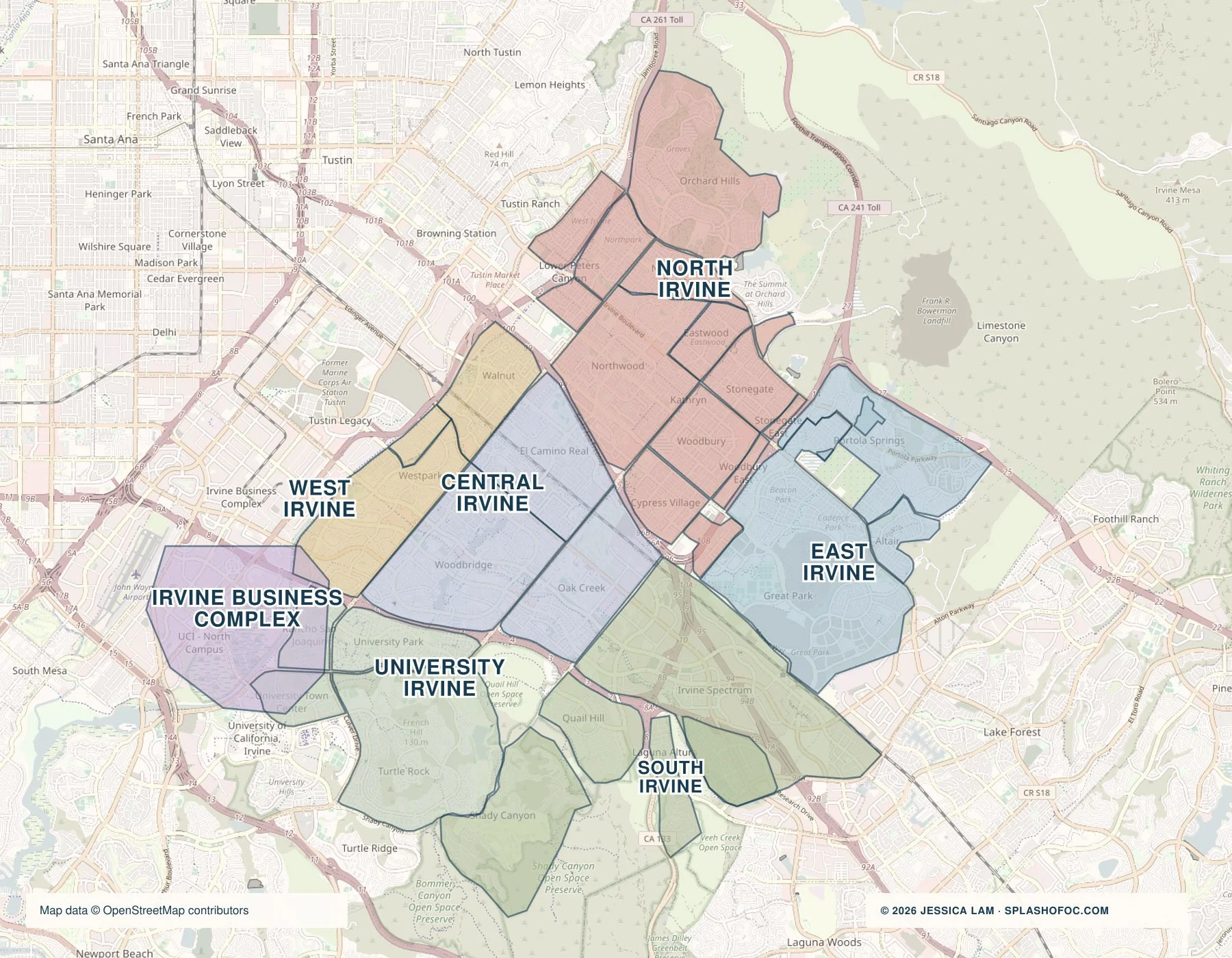
Irvine is made up of distinct villages and neighborhoods, each with its own home styles, amenities, parks, and character. This guide organizes Irvine into six areas to make it easier to understand how the city fits together and explore the communities that interest you. Use the interactive map to see where Irvine’s neighborhoods and villages are located, then explore the individual guides and homes for sale below.
This Irvine Neighborhood Guide was created by Jessica Lam, a real estate agent with First Team Real Estate and member of the National Association of REALTORS®, using local knowledge and firsthand real estate experience throughout Irvine and its communities.
IRVINE AT A GLANCE
Start with the area.
-
North Irvine includes Cypress Village, Eastwood Village, Gateway Village, Northpark, Northwood, Orchard Hills, Stonegate, and Woodbury.
The area includes a mix of established neighborhoods and newer planned communities, with parks, pools, trails, shopping, and residential options ranging from attached homes to larger detached properties.
-
West Irvine includes Westpark, Walnut Village, and the Irvine Business Complex.
This part of Irvine sits close to major employment centers, John Wayne Airport, the 405, shopping, dining, and many of the city’s central destinations.
-
Central Irvine includes El Camino Real, Oak Creek, Orangetree, and Woodbridge.
These communities include some of Irvine’s more established neighborhoods, with a broad mix of home styles, mature landscaping, parks, recreation, and central access across the city.
-
The University area includes Rancho San Joaquin, Turtle Ridge, Turtle Rock, University Park, and University Town Center.
The area includes university-adjacent housing, established neighborhoods, hillside communities, parks, trails, open space, and convenient access to UCI.
-
South Irvine includes Irvine Spectrum, Laguna Altura, Los Olivos, Quail Hill, and Shady Canyon.
The area ranges from residential communities near trails and open space to newer development, gated neighborhoods, and the shopping, dining, and employment centers around Irvine Spectrum.
-
East Irvine includes Portola Springs, Great Park, Altair, and Lambert Ranch.
This part of Irvine includes many of Irvine’s newer neighborhoods and planned communities with extensive parks, pools, trails, open space, and a mix of attached and detached housing.
EXPLORE IRVINE
Explore Irvine's Neighborhoods & Villages
Browse Irvine's villages and neighborhoods, search by name, or select an area to narrow the guide.
No neighborhoods found.
Try another search or clear your filters.
Irvine Neighborhoods FAQ
Common Questions About Irvine Neighborhoods
-
For this guide, I’ve grouped Irvine into six broad areas: North Irvine, East Irvine, Central Irvine, West Irvine, University, and South Irvine.
These are meant to make a large city easier to explore rather than represent official city boundaries.
Each area contains several of Irvine’s individual villages and neighborhoods, ranging from established communities such as Woodbridge and University Park to newer master-planned communities such as Portola Springs and Great Park. -
Irvine is known as a city of villages because it was designed as a collection of smaller, master-planned communities within the larger city. Each village was planned around everyday life, with homes connected to parks, schools, recreation, trails, shopping, and other amenities. Within a village, you may also hear individual communities or residential areas referred to as neighborhoods. In everyday conversation, though, people often use “village,” “community,” and “neighborhood” pretty loosely.
-
Many of Irvine’s newer communities are concentrated in the northern and eastern parts of the city, including Great Park, Portola Springs, Orchard Hills, and Eastwood Village.
Irvine also has much more established communities, including Woodbridge, University Park, Turtle Rock, and Northwood.
If the age of the home matters to you, Irvine offers everything from neighborhoods built decades ago with mature trees and established amenities to newer communities with contemporary floor plans and newer construction. -
Turtle Rock, University Park, Rancho San Joaquin, University Town Center, and Turtle Ridge are among the communities closest to UC Irvine, with University Town Center directly across from the campus.
But you don't necessarily need to live in the University area to have convenient access to UCI. Irvine is well connected, and people commute to the university from neighborhoods throughout the city as well as nearby communities in Tustin, Lake Forest, and other parts of Orange County.
Actual commute times vary depending on where you live, the time of day, and traffic. -
Irvine is a major Orange County employment center, with companies and organizations spanning technology, healthcare, automotive, gaming, finance, education, and other industries.
Major names with headquarters or significant operations in Irvine include Edwards Lifesciences, Rivian, Blizzard Entertainment, Broadcom, Mazda, and Alteryx, along with UC Irvine and many other employers.You also don't have to choose a home right next to your office. People who work in Irvine live throughout the city and in neighboring communities such as Tustin and Lake Forest. If you're relocating for work, your office location is still a useful place to start, but commute, budget, home style, schools, and the kind of neighborhood you want can all factor into where it makes sense to live.
-
The right Irvine neighborhood really comes down to what you want around you and the type of community you want to come home to.
Some villages are newer and more amenity-focused, while others have mature trees, larger lots, established parks and a completely different feel.
Location within Irvine can also change how close you are to work, shopping, trails, the coast, or neighboring cities.I suggest exploring a few different parts of Irvine before narrowing it down. You can look at homes online all day, but driving through the villages, visiting the parks and shopping centers, and seeing how each area feels can make the decision much easier.
If you're not sure where to start, tell me what you're looking for and I can help you narrow down the Irvine communities that may be worth exploring.
-
HOA fees and Mello-Roos can vary quite a bit throughout Irvine, sometimes even within the same village.
A home may have a master HOA, an additional neighborhood HOA, special assessments such as Mello-Roos, or some combination of these.
There are also Irvine neighborhoods with no HOA or no Mello-Roos at all.Rather than looking at any one fee by itself, I think it’s more useful to understand the complete cost of owning the home and what you’re getting in return.
Two similarly priced homes can have very different property taxes, assessments and HOA dues, while those HOA fees may also include amenities or services you would otherwise pay for separately.When comparing homes, I help buyers look at those costs together so they can make a more meaningful comparison.
For a specific property, Mello-Roos and other special assessments can also be verified through Orange County property tax records.
Irvine Neighborhood Guide · Last updated September 2026
A WORK IN PROGRESS
There’s more to explore.
This is the beginning of a growing guide to Irvine’s villages, neighborhoods, and the places that make each part of the city distinct. More detailed village guides, local resources, and market insight are on the way.